
Contact us: 905-531-7548
Project Overview
When a client required secure and efficient access to shipping containers (seacans) stacked two-high on their worksite, our team was tasked with designing and constructing a scaffold system that would meet strict safety standards while providing practical usability. The goal was to allow workers to safely load, unload, and inspect materials stored inside the upper-level sea cans without the use of ladders or mobile lifts.
The Challenge
When a client required secure and efficient access to shipping containers (seacans) stacked two-high on their worksite, our team was tasked with designing and constructing a scaffold system that would meet strict safety standards while providing practical usability. The goal was to allow workers to safely load, unload, and inspect materials stored inside the upper-level sea cans without the use of ladders or mobile lifts.
Stacking sea cans is a common way to maximize limited yard space, but it introduces a serious access challenge. The top containers often sit over 8 to 10 feet above ground level and have limited clearance between them. Traditional ladders were not an option due to safety concerns and the need for hands-free movement during loading operations.
The site’s conditions added further complexity:
- Limited surrounding space / clearances meant the scaffold had to be compact and self-supporting.
- Frequent site access demanded a design that could offer proper access and egress.
- Security at the factory was critical due to the nature of the client’s business
The Solution
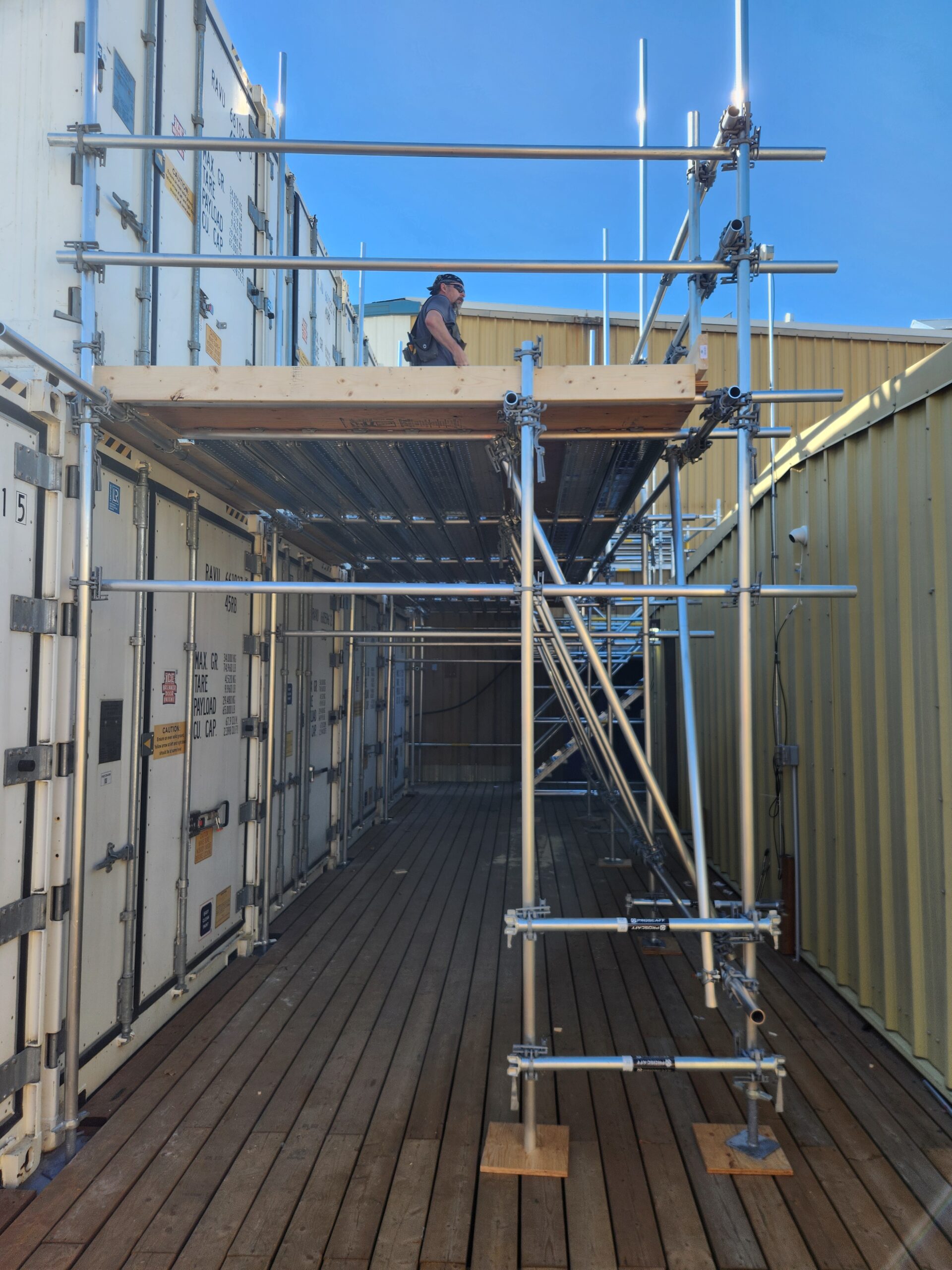
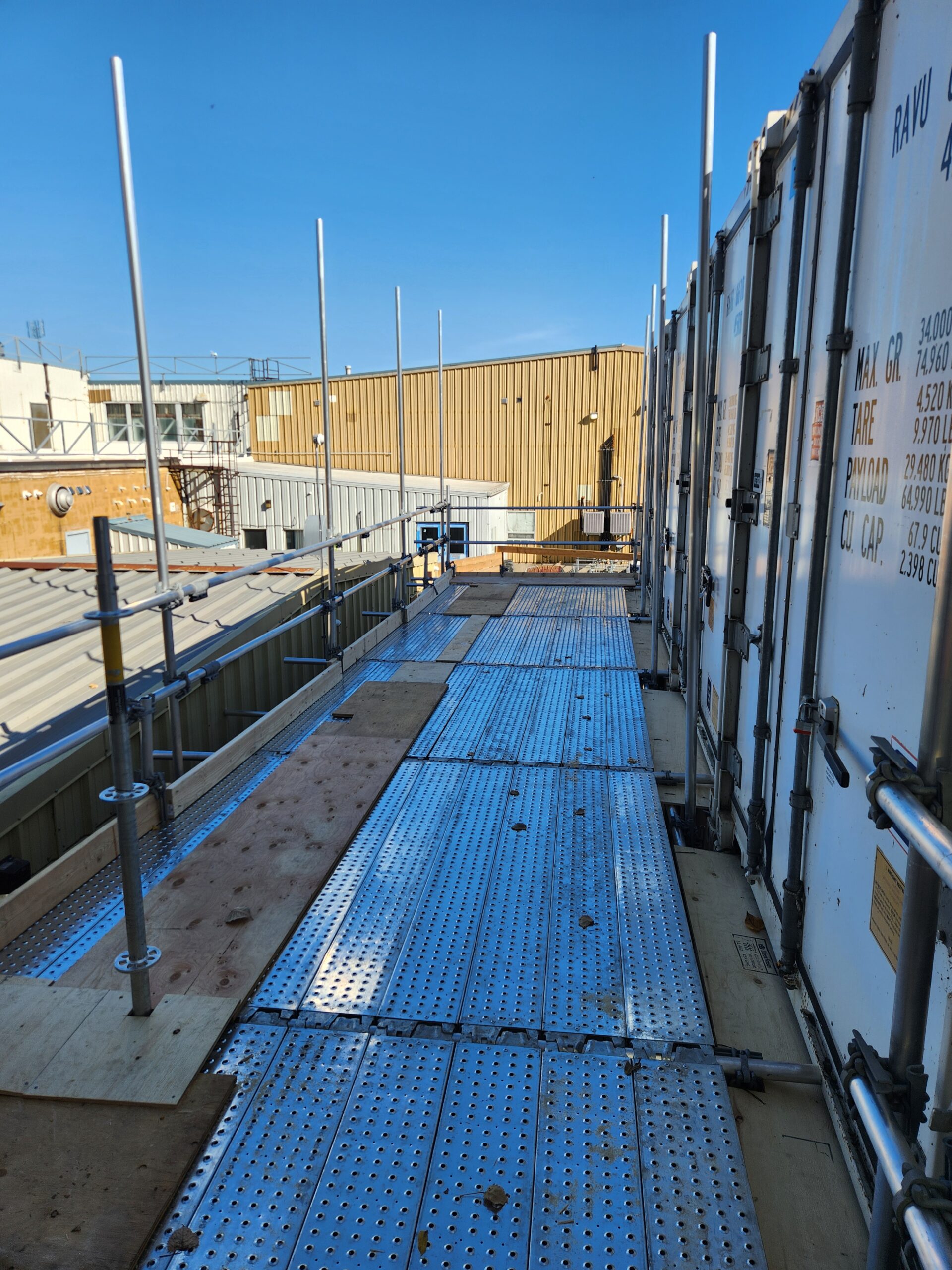
To address these challenges, we developed a custom scaffold access using a mix of both ring-lock and tube & clamp systems. The structure was engineered to provide stable access to the upper containers while allowing clear workspace at ground level.
Key features of the design included:
- Independent scaffold tower: Built alongside the stacked seacans, fully braced and anchored to prevent sway or movement.
- Custom platform alignment: The upper platform was aligned precisely with the seacan doors for seamless access
- Guardrails and toe boards: Installed along all working platforms and edges for complete fall protection of workers and materials
- Access stairs and landings: A stair tower with intermediate platforms allowed safe, progressive access to the upper level.
Stacking sea cans is a common way to maximize limited yard space, but it introduces a serious access challenge. The top containers often sit over 8 to 10 feet above ground level and have limited clearance between them. Traditional ladders were not an option due to safety concerns and the need for hands-free movement during loading operations.
The site’s conditions added further complexity:
- Limited surrounding space / clearances meant the scaffold had to be compact and self-supporting.
- Frequent site access demanded a design that could offer proper access and egress.
- Security at the factory was critical due to the nature of the client’s business
- Weather protection options: Integration for temporary canopy or tarping during adverse conditions.
- Adaptability: The scaffold is setup for future storage container configurations
Implementation
The scaffold was built by a 3-man crew over the course of two work days. Careful planning ensured security on site and minimal downtime. All materials were inspected before erection, and the setup was completed by certified Red Seal Carpenters.
During use, workers were able to safely load and unload equipment from both levels without incident. Appropriate clearances were maintained and the modular design also allowed the scaffold to be relocated to another part of the site as the project evolved.
Results
- Improved safety: Eliminated ladder use and reduced fall risks.
- Increased efficiency: Workers accessed upper containers faster and with better mobility.
- Flexible design: Scaffold was adaptable for future container configurations.
- Regulatory compliance: Fully met safety standards and inspection requirements.
Lessons Learned
This project reinforced the importance of designing access systems around both safety and functionality. Even simple container stacks can present complex access challenges, but with careful planning and the right scaffolding strategy, it’s possible to achieve a safe and efficient work setup that adapts to the site’s needs.